Fix: Remove Start Up Password in Windows 7/8 and 10

In the last few months, a number of users have reportedly received calls from scammers impersonating Microsoft or other big names in the IT industry. These scammers call the users by looking up their names on the internet, and spin a story about their computers supposedly sending out viruses, being hacked, or presenting other issues to pique their interest. Unaware users who fall for this ruse grant these scammers access to their PCs. The scammers subsequently trick these users into purchasing something from them for a few hundred dollars. If the user refuses to pay, the scammers set up a startup password, which locks down the computer and encrypts the files. This process is technically defined as “the encryption of the SAM hive in the registry.

Now in simple terms, to restore your computer and remove the password, ‘you need the original registry.’ We’ll try to accomplish this with the help of this guide.

Using the Registry Edit Utility to Restore the Registry Hive from RegBack.

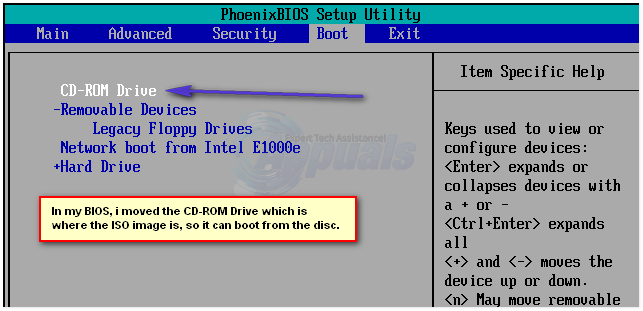
To perform this method, you would need to know how to access the BIOS in order to select the proper boot device, which could be either a CD or a USB. Additionally, you will need the RegistryEditor ISO (We are no longer hosting this ISO – Please Google it for a mirror) and write it to the disc/USB using MagicISO or another ISO Burning Program.

  1. If you don’t know how to boot to bios, see the manufacturer’s manual for your system.
    2015-11-14_001851
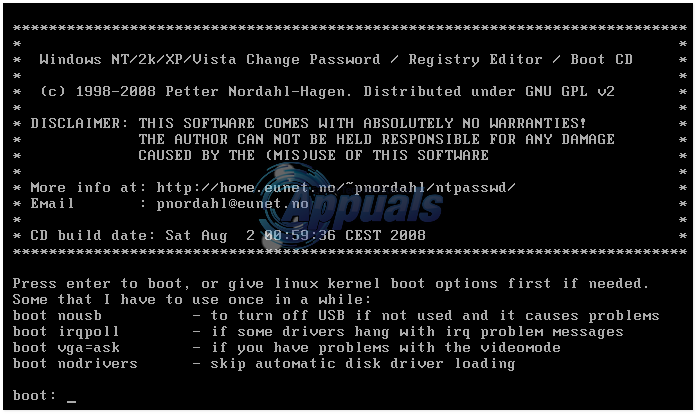
  2. Once you’ve booted from the registry and started correctly using the ISO image, you will see a black screen of this type.
    2015-11-14_002050
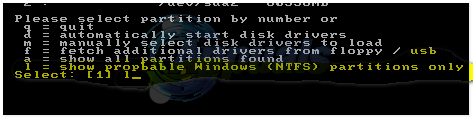
  3. Wait a few minutes until it takes you to the prompt that shows: ‘Select: [1]’.
  4. Type ‘l’ and hit ‘Enter’ in the prompt to see your Windows partitions.
    2015-11-14_002315
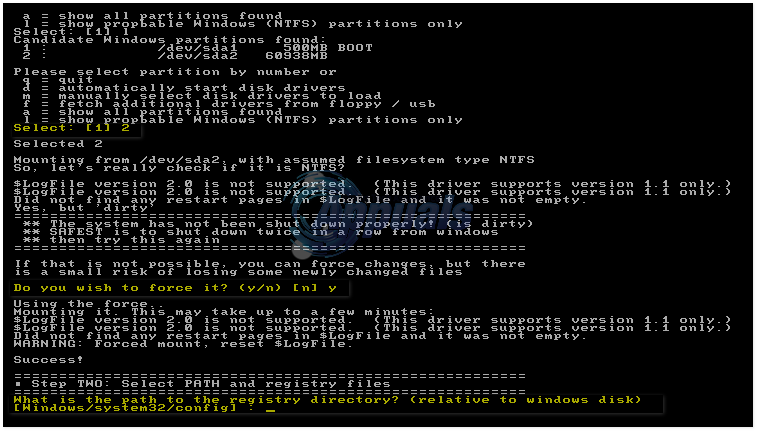
  5. Then, choose your Windows Partition from the list. In my case, on VMWare, it is [2], so I chose 2 and then pressed Y to confirm if I wished to force it.
    2015-11-14_002559
  6. The next prompt will be [Windows/system32/config] : _
  7. Type Windows/system32/config and Hit Enter.2015-11-14_002843
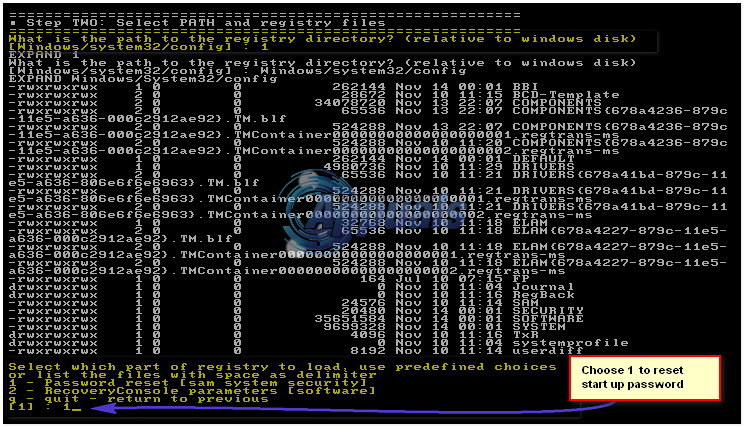
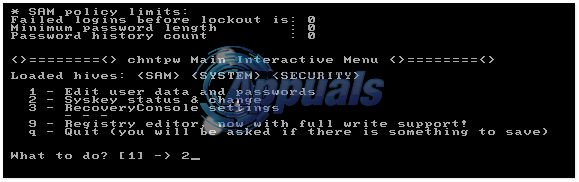
  8. Then type 1 and press Enter. It will then prompt you with the following options:
    2015-11-14_003142
  9. Choose option 2 here: “syskey status & change.” The next prompt will then ask if you truly wish to disable syskey. At this stage, type ‘Y’, then hit enter followed by ‘Q’. Afterwards, it should inquire if you want to confirm the overwrite. Confirm it, then return to the BIOS, alter the boot order, and elect to have the hard disk as your primary boot device. Once finalized, save the changes. Then, restart and exit. This process should resolve the start-up password issue.

Removing the start-up password after logging in is possible.

This method is only for those who were able to successfully log in using the guessed passwords.

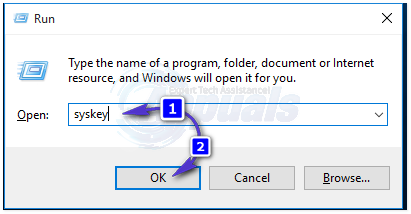
  1. After logging in with the default passwords, hold the Windows Key and press R. In the run dialog, type ‘syskey’ and click OK.syskey 1
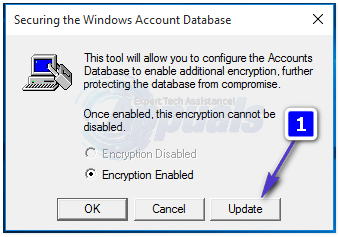
  2. Then click the Update option.
    start up password 2
  3. Then, choose ‘System Generated Password.’ Next, select the second option labeled ‘Store Startup Key Locally.’ Once completed, re-enter the default password you used to log in and select ‘OK.’
    start up password 3
  4. A confirmation will appear on the screen stating, “The account database Start-up key was changed.” Click ‘OK.’ This will remove the password. Remember, never grant anyone access to your system who claims to be from Microsoft or elsewhere, as there are many tech support scams out there. You might put yourself at risk by following their instructions.


ABOUT THE AUTHOR

Kevin Arrows


Kevin Arrows is a highly experienced and knowledgeable technology specialist with over a decade of industry experience. He holds a Microsoft Certified Technology Specialist (MCTS) certification and has a deep passion for staying up-to-date on the latest tech developments. Kevin has written extensively on a wide range of tech-related topics, showcasing his expertise and knowledge in areas such as software development, cybersecurity, and cloud computing. His contributions to the tech field have been widely recognized and respected by his peers, and he is highly regarded for his ability to explain complex technical concepts in a clear and concise manner.

Comments

26
    BR
    brentrjones Jan 30, 2016

    The scam team from India have now deleted all registry backups. So it is not going to work anymore.

      KA
      K. Arrows Author Jan 30, 2016

      In that case, only option is to do a clean install or guess the usual passwords they use. You’ll have to do a Google Search on it.

    RS
    Robert Smith Jun 23, 2016

    Try 123 as the password. When it happened to me it was 1234, try passwords like that.

    Reply
      KA
      K. Arrows Author Jun 23, 2016

      Good suggestion.

        RK
        Ryan K Feb 11, 2017

        my client’s laptop locked up with syskey after a “Microsoft Support” phone call…. I tried guessing the password and got it on the second guess. LMAO

        123456

          PE
          Pedalpusher Apr 14, 2017

          mine came up with 123456789 as the password. They seem to like simple numbers don’t they!

          KA
          K. Arrows Author Apr 14, 2017

          cool.

          SG
          Sahil Gupta Apr 27, 2017

          please also try followinowing other passwords 1234, 12345, 123456 as they are most commonly used by Scammers.

    JM
    jmaine08 Jul 11, 2016

    Just had this happen to someone I know, and was asked to help fix. Tried guessing the password but that didn’t work out. The method above seemed to work fine until the end, gave me an error saying the partition failed to unmount properly as I tried to exit.

    My solution was I found a product that pretty much used brute force using commonly used syskey passwords by scammers (among other things). About 10-15 minutes after it started, it found it! The password in this case ended up being a measly “mike123″…smh.

    I was able to log in, change the syskey encryption back to being system generated as you mentioned. All files still present. Ran a few malware scans and that computer was back in business. Of course I had to educate the user so something like this hopefully wont happen again.

    Reply
      KA
      K. Arrows Author Jul 11, 2016

      Thanks for the info. Which program did you use to bruteforce the issue? I’ll add your suggestion as a method to this post.

    TM
    Tom McNamara Aug 8, 2016

    Hi, I tried this solution and was able to remove the password (as far as I can tell anyways) now the computer just continues to reboot. Any Thoughts?

      KA
      K. Arrows Author Aug 8, 2016

      What’s the final screen it can get to before looping?

        TM
        Tom McNamara Aug 9, 2016

        It shows the partitions then spits out a few lines about SCSI and gets stuck.

          KA
          K. Arrows Author Aug 9, 2016

          Did you change the boot order? Also, type me the complete and exact message being shown before it gets stuck

          TM
          Tom McNamara Aug 9, 2016

          Ok, after 3 tries I was able to perform the steps shown. Not sure what happened, but thanks for your help.
          Unfortunately now the PC continually reboots with no prompt for a password.

          KA
          K. Arrows Author Aug 9, 2016

          So is it now working? it could be that the boot record has gone corrupt. Not sure if you followed steps to the letter but i would suggest doing a repair install now.

          TM
          Tom McNamara Aug 9, 2016

          Thanks for following up. I ran out of patience and pulled the drive out, copied files to USB from another computer and reinstalled OS.
          I hope someone catches these guys, although I doubt it.

          RK
          Ryan Kosman Sep 2, 2016

          I’m having the same problem with an infinite reboot. I performed all of the steps shown on a Windows 10 computer and now it reboots twice before giving me an “automatic repair” and a message that my PC did not start correctly. Do you have any advice for how I can repair the boot on this computer? I don’t get any other error messages.

    MK
    Max Kerneck Aug 30, 2016

    That program Offline NT Password & Registry Editor will not work on Windows 8, 7, Vista, or any higher version than
    Window XP. (Using it on Vista or windows 7 will cause a continuous
    reboot loop.

    Reply
      KA
      K. Arrows Author Aug 30, 2016

      Hi Max,

      I will update the guide. Thank you for pointing out. Do you have a better solution?

    SG
    Sahil Gupta Apr 27, 2017

    HI i somehow figured SYSKEY password but after that I saw RESTORE option on my computer instead of normal statup. How to get normal statup.

    AI
    Ashley Creates It Aug 31, 2017

    After years since I fell for this scam, FINALLY a solution that worked! THANK YOU!!!!

    TR
    Trainingday Sep 5, 2017

    This worked but please add after pressing Y I had to press Q then takes me to step
    4 and it ask if I want to write back and when I press yes I finally got it to work. Before I was restarting after your instructions to go back to bios.

    Reply
      KA
      K. Arrows Author Sep 29, 2017

      I’ve updated the article. Please check.

    CH
    Choz Nov 15, 2017

    Try 1111 or 0000 or 1234 or 123456 for the password. One of these just came in to helpdesk and I tried 123456 and BINGO!

    Reply
    JB
    Jonathan Boffey Nov 22, 2017

    Indian scammer called by 83yr old father pretending to be BT after he had reported a broadband speed issue. Obviously inside job…. Scammer got remote access via Supremo and set syskey password. 123456 plus syskey removal instructions above works well. Thanks to all.

    Reply