Fix: FaceTime Camera Not Working on MacBook
Many users are reporting problems when trying to use their Mac’s FaceTime cameras. Whenever they launch FaceTime, this error pops up “No camera Available. To use FaceTime, connect a camera.”
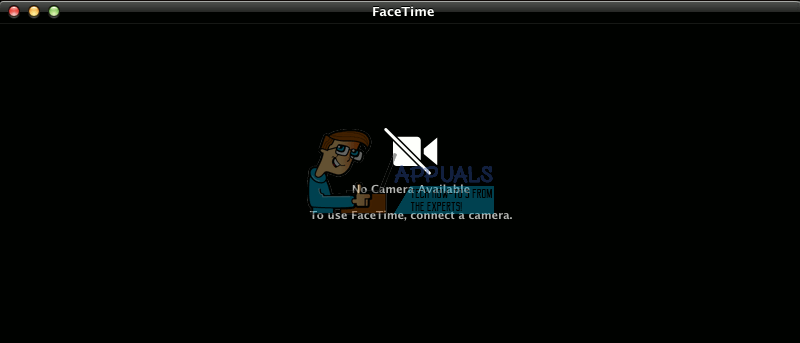
Why exactly is my FaceTime Camera not Working on my MacBook?
While using your Mac’s web camera, OS X or macOS launches a background process known as VDCAssistant. It manages the connection and control of the webcam. This process quits when you stop using the camera. However, in some cases, an error occurs, and the VDCAssistant process persists. This prevents future connections to the camera by any app. Whenever users launch a program or service that uses the camera the “No Connected Camera” error will appear. To fix this error, you will need to perform the fix explained below.
How to Get the Camera to Work on FaceTime on a Macbook
To fix the problem with your FaceTime camera, you will need to force-quit the VDCAssistant process. So, the services and programs that use this process will be available to rerun it when needed. That’s how the camera-to-program connection will be established again. To do that follow these steps.
- Quit any app using the camera (FaceTime, Skype, etc.).
- Launch Terminal. (Go to the Applications folder > Open Utilities > Double-click the Terminal application)
- Type the following command (without the quotes) and run it: “sudo killall VDCAssistant”
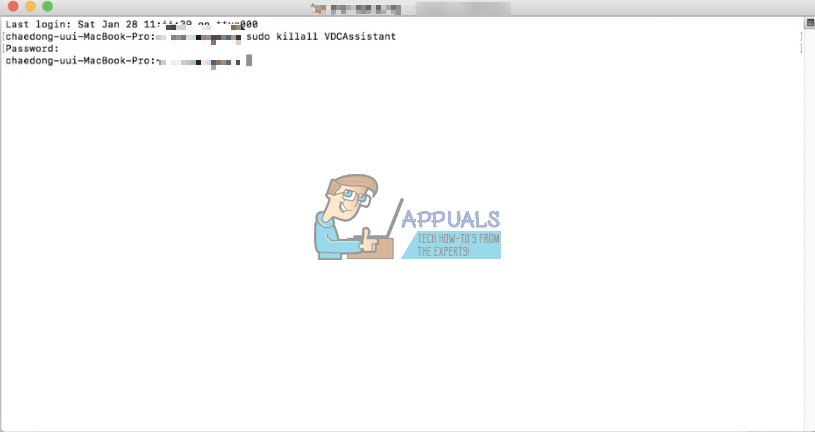
- Enter your password if required. (Keep in mind that your password will not show while typing it)
- Now, try relaunching the program (Skype, FaceTime, etc.) using the camera.
This fix should fix the problem with your Mac’s camera.
Still Having the Same Problem?
Besides the VDCAssistant process, other system configurations and problems may lead to similar behavior. Iff you use a MacBook attached to an external monitor, then one factor might be if you use the system in clamshell mode. This is when you keep the lid closed and only use the external monitor as a main display. While doing this, the built-in microphone and speakers will work, but the camera won’t. It shuts down automatically and stays unavailable for programs that need it. In case you use Messages or other video-chat-capable app, you can still make audio chats, but not video calls. If you want to use your Mac’s camera you must open the lid of yoru MacBook.
Another factor are the USB connectivity issues that may occur from an error that might have appeared with the drivers in your OS, or incopatibility with some third-party USB devices (Cameras, Keyboards, Hubs). This ussualy happens if you use a third-party USB drivers. However, sometimes the USB device itself is causing faults in your system. Most of the times this is just a temporary issue. If thinking that this is happening on your Mac, try the following steps, and check if the problem is fixed after each step.
- Turn off (or unplug) the third-party USB devices.
- If that doesn’t help, restart your Mac while the third-party USB devices are disconnected, and try using your Mac’s camera.
- Plug the USB devices back in and try if the camera works again.
If any of the previous steps doens’t give you the wanted results, try unplugging all the USB devices (mouse, keyboard, etc.) from your Mac. Restart the system, and see if the problem continues.
Troubleshooting in this manner wil help you identify the specific device that may be the cause for the problem. When you do find the culprit, try leaving that device unplugged. You should also update its drivers and other software, and apply any available firmware updates. If none of that helps, contact the manufacturer to see if a known solution is available. Often such problems happens with the use of USB hubs and other dongle solutions. In addition to easily identify specific devices, try changing the order in which they are attached to your Mac (swap USB ports, bypass a USB hub).
Conclusion
According to our readers, in a majority of cases force-quitting the VDCAssistant process fixes Mac’s camera problem. For some disconnecting the third-party USB devices also helped in solving the issue. Let us know what was the cause for your Mac’s camera problem in the comments below. Also, share if you are aware of any other method that helped you in fixing this problem.

In a related issue… This is something that has both dogged and annoyed me for several major releases of macOS. I have had Macbook Pros and Mac Minis for a number of years, running in clamshell mode (Mac Minis, simply without a camera). I use FaceTime Continuity iPhone Cellular Calling, daily, in my business. Apple states it supports FaceTime for making and receiving either audio or video calls, in its own documentation. It also gives the availability of a camera as a prerequisite only if you want to make/receive video calls.
Further details on system requirements, here: https://support.apple.com/en-au/HT204689 and here: https://support.apple.com/en-us/HT209456
However, over at least the last five years, following each update to the newest major release of macOS, I have lost the ability to use FaceTime because it tells me “No Camera Available. To use FaceTime, turn on the camera.” Then, normally after months of living with this (undocking the laptop and opening it, or grabbing a webcam and plugging it in, so FaceTime can detect the camera and start working, each time I launch it), Apple seems to fix the issue and FaceTime works happily, without needing to detect the camera. But only until the next major update.
When I moved to Big Sur, I was having to do the workaround, opening the laptop lid, until Apple released an update (couldn’t tell you which one), after which FaceTime worked without complaint. I recently moved to Monterey, 21.1 and I’m back with FaceTime complaining about no camera.
With all the major software producers slashing budgets, normally starting with QA, we are all doomed to a Groundhog Day existence of needless software bugs reappearing, as this is clearly an example of.